
Quiet Pickleball Courts Boost Player Focus & Community Harmony
Quiet Pickleball Courts Boost Player Focus & Community Harmony
Pickleball is the fastest-growing sport in America, cherished for its accessibility and potent health effects.
But the sport is equally known for its distinctive noise! The dull/wooden ‘pop’ of the paddle ball has started becoming a major issue wherever there are courts in an urban area. The people have noticed. And the people started complaining.
If we want to preserve pickleball as a sport, then we definitely need to do something about it. Step one is being aware that this is an actual problem, not just a second-grade nuisance. And this isn’t even about dealing with complaints; it’s also an opportunity in disguise – a way of making pickleball better than it already is.
In this article, we’ll go over a couple of tested and proven solutions, and we’ll discuss the major gains of promoting a quieter listener in pickleball.
Controlling The Noise
Noise Control is a dual-level approach that targets the source (the equipment) and the physical environment:
The Equipment
- The next-gen low-noise pickleball paddles were designed to do what their description says – to reduce the noise that comes from hitting the ball repeatedly.
- To make the noise reduction possible, low-noise paddles are made with special materials (e.g., dampening polymer, polypropylene cores, milder surface textures, etc.). This design is made to reduce the loud, high-frequency pop (normally in excess of 85 dBA) into a quiet thump (frequently 65-75 dBA).
- The use of such equipment allows players to have a great time while showing their neighbors R-E-S-P-E-C-T; a good experience for everyone involved (directly and indirectly).
The governing body for pickleball in the U.S., USA Pickleball (USAP), has official guidance for all communities and clubs on U.S. soil regarding quiet-certified/acoustic equipment.
Products in this category decrease acoustic output by around 50 per cent versus standard products, which typically put out 80 dBA.
The USAP demands that the player have these low-noise paddles and balls, and the facility operators can comply with local sound codes directly, as well as show a powerful belief in the removal of noise to appease the neighbors and keep the joy in Pickleballing.
PickleballNation’s CEO, Todd Skezas, also had something to say regarding loud noise produced by the sport: “You have to be aware of noise levels; that’s crucial, especially in residential areas, because you don’t want to disturb the neighbors – that’s never good for the community.”
Environment
- The Approach: Implement high-mass (12–14 feet) acoustical sound barrier fences with non-porous materials. For indoor or covered courts, install sound-absorbing baffles and panels (sometimes made up of dense foam or fiberglass) over and along the walls.
- Acoustic Theoretical Principle: Thick fencing reflects sound away from sensitive areas, and porous baffles absorb sound energy, converting it into heat and preventing reflection.
- Use Strategic Court Placement and Surface Dampening: In constructing new courts, the most important opportunity is an initial design to reduce noise.
- Strategy: Set courts as far away from any line of property as possible. Also, make courts a little further apart to lessen the impact of play noise and fan noise.

Control and Communicate Playing Times
Not a sound-reduction technique per se, but establishing specific playing hours is a good way to have a good-faith effort of goodwill for communities and a compromise between the two.
What you can do is to set up rules that limit play in sensitive hours, including early mornings (before 8:00 AM) and late nights.
This guarantees neighbors don’t get disturbed at rest.
When you control play time, you also reduce other physical noise, so it has the ability to affect the neighborhood’s tolerance and prevent expensive litigation or total shutdowns of a court.
How Quiet Play Rewards Players
Quiet games can actually benefit you – the player – both mentally AND physically.
If you’re trying to play in a noisy court, your mind will be forced to work overtime. You might not notice all the noise. But be sure that your brain does. And doing that ‘extra work’ (aka cognitive load) requires energy, which you could otherwise spend on the actual court to play.
Playing in a quiet place slows the body’s stress response, meaning that less noise equals less stress on players. Less stress, less mental fatigue, less being overly jumpy – everything you want to avoid while you’re looking to have fun.
More Access and Venue Opportunities
If you have a venue/court in an urban environment, then you should definitely soundproof the entire infrastructure, and you should use low-noise/quiet equipment because you’ll disturb the neighboring residents otherwise.
This way, you’re making the entire place more inclusive and accessible for groups with sound sensitivities, plus you won’t have any worries about being reported for disorder.
This promotes greater community engagement like Uscreen refers to, and makes the sport attractive to newcomers.
Community Relations
A court that respects its neighbors is a sustainable community asset.
No one wants an establishment that creates noise in the evening or even in the middle of the night, and it doesn’t matter whether we’re talking about a pickleball court or a nightclub. Noise is noise. And if you’ve ever experienced such an issue, then you know how much of a bother it can be.
No one wants a frustrated community with neighbors who hate you for working there or playing/training.
If you’re a one-time player, you might not care. But if you’re a regular, it’ll bother you. And your neighbors, whether they like it or not, they’re basically indirect ‘regulars’ all the time.
If all the loud noise is handled the proper way, it creates a peaceful coexistence. It helps keep facility operators AND players. Plus, to top it all off, it basically ensures your court survives.
Good for business; good for the community.
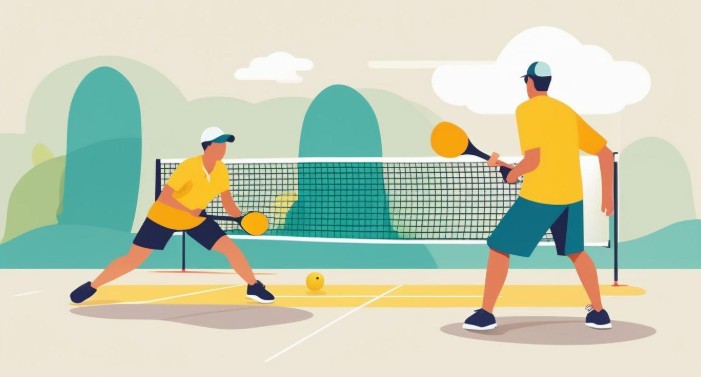
The Perfect Sports + Fitness Combo
There’s no need to discuss compromises here. If the pickleball court causes too much noise, then the owners need to do something about it. The players can do their part as well – use more low-noise paddles.
Once this has been taken care of, everyone will benefit from it – the athletes, the community, and the entire future of pickleball as a whole.